How Can a Two-Berth PCIP Terminal Accommodate 2 Million TEU containers?
Only LA, Long Beach, and Vancouver handle more.
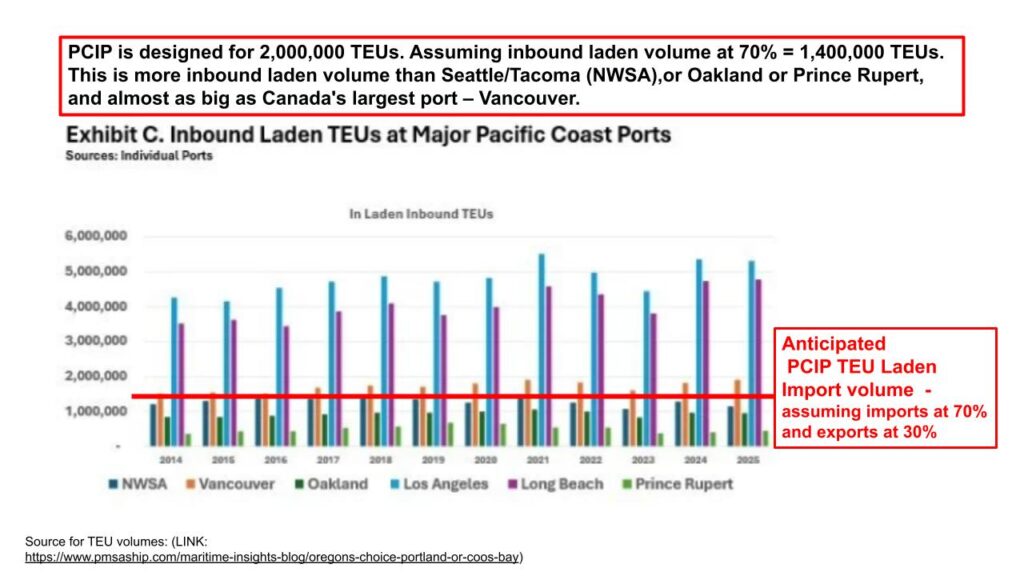
More 2026 Expansion Plans for Ports on the West Coast of North America
Port of Long Beach
A doubling of the size of the rail yard facility, to be completed by 2032, will support 30 locomotives and trains up to 10,000 feet long and increase the volume of on-dock rail cargo from 1.5 million to 4.7 million TEUs annually.
The Port of Long Beach is projected to move 20 million containers annually by 2050 and the Port is exploring the development of the first zero-emissions container terminal in the world.
Ensenada, Baja California Sur, Mexico
Hutchison Ports is completing a major expansion to increase capacity to more than 7,500 TEUs annually.
Manzanillo, Colima, Mexico
A $3 billion investment program will double the capacity of the largest port on the west coast of Mexico from 3.7 million TEUs to 10 million by 2030. The port is served by CNKCS rail providing direct service to Midwest US destinations. Letters of interest have been received from 13 of the world’s largest shipping companies.
Lazaro Cardinas, Michoacan state, Mexico
The Port plans to expand docks and construct access roads to increase volumes from 4 million TEUs to 8.2 million. Global giants APM and Hutchinson Ports, own container terminals at the port, and APM is using automated, emission-free electric ARMG cranes and hybrid shuttle carriers. The port has Canadian Pacific Kansas City rail service with transit to Chicago in eight days.
2026 Plans for Ports on the West Coast of North America
The Port of Prince Rupert, British Columbia
The Port is undertaking a feasibility study for a new 2 million TEU container terminal This would double their container handling capacity. Estimated completion 2030-31.
Vancouver, British Columbia
In November 2025 three construction teams were invited to submit bids for the first construction phase of the Roberts Bank Terminal 2 project. This all-new rail served terminal has a 2.4 TEU capacity. Construction to begin in 2028.
Northwest Seaport (Seattle/Tacoma)
The Port of Tacoma and the U.S. Army Corps of Engineers have begun design work to deepen the navigation channel to -57ft. and create deeper ship berths. Dredging is expected to continue through 2029.
Supply Chain and Rail Experts Weigh in on the PCIP Plans
The Coos County League of Women Voters organization recently held a public meeting focusing on how container shipping and rail transport operate on the west coast. The program included panel members with decades of experience in the container shipping industry, supply chain economics, and railroad engineering and operations. A recording of the presentation, along with biographical info on each speaker, is available in three parts on the League’s YouTube channel.
An article in the local Coos Bay newspaper, The World, summarizes the information presented.
The Millersburg and Nyssa Truck to Rail Terminals Fiasco – Is this the fate of the PCIP?
Two intermodal terminals were built in Oregon to move goods to Seattle and Tacoma ports by rail to get trucks off the highway. The Millersburg terminal was built to send hay and grass seed and the Nyssa terminal built to send onions.
Experts warned that the projects would fail but despite this the Oregon Legislature allocated more than $70M to the projects.
Neither has ever been used.
The Nyssa project, costing $37M of public money, was recently sold for $10M.
West Coast Port Expansions
Port of Los Angeles – Expansion plans and pollution reduction
The Port of Los Angeles plans to build a new container terminal to meet global supply chain demands. The plans call for a 200-acre site with two berths and 3,000 linear feet of wharf. In 2024, the Port achieved record emissions reductions, despite a 19 per cent year-on-year increase in container throughput.
Port of Long Beach – Expansion Plans
The Port of Long Beach has broken ground on a $365 million terminal expansion project to build a 3,400ft wharf that will allow two of the industry’s largest cargo ships to dock.