Even More 2026 Expansion Plans for Ports on the West Coast of North America
Port of Vancouver, Canada
Canada has committed the funding to develop a new three-berth container terminal adding 2.4 million TEUs to the Roberts Bank Terminal. The final project completion is anticipated in the mid-2030s.
Port of Tacoma
The shipping company HMM is adding four new cranes to its Washinton United Terminal which is served by BNSF and UP railroads. The upgrade will enable the terminal to handle larger container vessels and increase its annual capacity from 590,000 TEUs to 880,000 TEUs.
Port of Long Beach
Total Terminals International, the Mediterranean Shipping Company’s terminal investment company, is planning a major redevelopment plan for Pier T to maximize on-dock rail. The Pier T terminal plans include automated and remotely operated equipment and an increase in zero-emission technology.
This upgrade is in addition to the port’s $1.8 billion Pier B On-Dock Rail Support Facility project, which aims to triple the port’s rail capacity by 2032. https://polb.com/port-info/projects#pier-b-on-dock-support-facility/americas-green-gateway-pier-b
Port of Lázaro Cárdenas, Mexico
Twelve automated electric cranes are part of a $33 million investment to optimize the handling of containerized cargo and reduce emissions. The addition is part of the terminal’s expansion, which includes the construction of an additional 345 meters of wharf, 28 hectares of operational area, and an increase in annual handling capacity from 1.8 million to 2.5 million TEUs.
A shipping association questions the role of the PCIP
The Pacific Merchant Shipping Association, a not-for-profit association focusing on issues affecting international trade has an article entitled, “The Unsung Role of the West Coast’s Smaller Container Ports”. It’s take on the PCIP is not positive. There is an error in the article – Points Consulting was contracted to provide the port with an updated strategic plan, not a PCIP feasibility study. That was the Rebel Group’s task.
Container shipping at the Port of Prince Rupert, Canada is declining. Will this be the fate of the PCIP?
Inbound cargo in June 2026 dropped 21.7% from a year earlier and is down 33.5% from June 2019. Outbound cargo was 19.5% below the volume shipped in May 2019. Total container traffic in the first half of 2026 is 22.6% below the volume handled in the same period seven years ago.
How will the Coos Bay to Eugene railroad improvements be financed?
The 2024 estimate for the direct costs of improvements needed for the 100 + year old rail road is ~$1.4 billion. To date the Port has received an $11.25 million Port Infrastructure Development Program (PIDP) award from the U.S. Maritime Administration, to undertake some track improvements on the North Spit of Coos Bay. The Port is pursuing long-term Railroad Rehabilitation & Improvement Financing (RRIF) loans to finance the remainder of the cost.
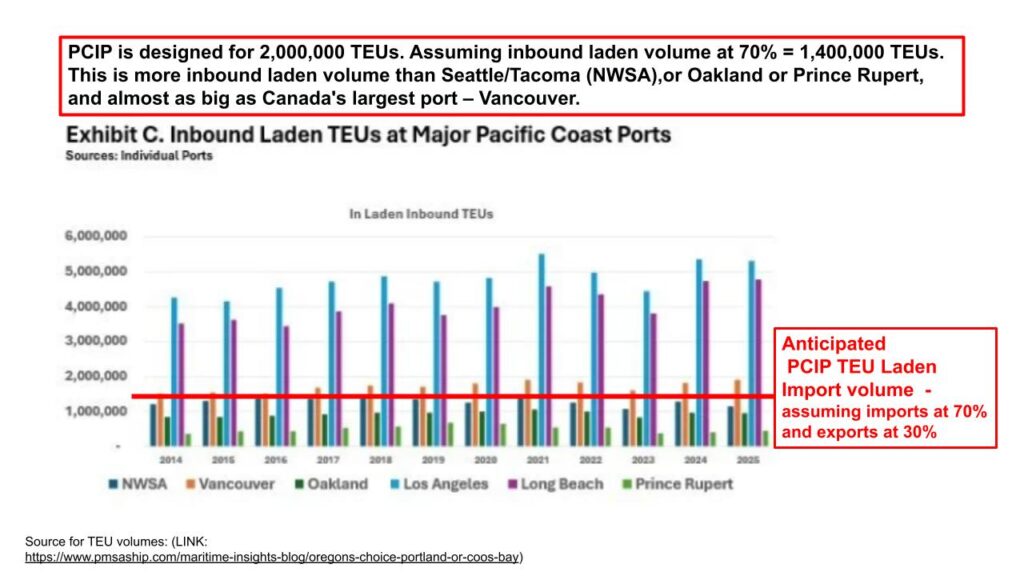
How Can a Two-Berth PCIP Terminal Accommodate 2 Million TEU containers?
Only LA, Long Beach, and Vancouver handle more.
More 2026 Expansion Plans for Ports on the West Coast of North America
Port of Long Beach
A doubling of the size of the rail yard facility, to be completed by 2032, will support 30 locomotives and trains up to 10,000 feet long and increase the volume of on-dock rail cargo from 1.5 million to 4.7 million TEUs annually.
The Port of Long Beach is projected to move 20 million containers annually by 2050 and the Port is exploring the development of the first zero-emissions container terminal in the world.
Ensenada, Baja California Sur, Mexico
Hutchison Ports is completing a major expansion to increase capacity to more than 7,500 TEUs annually.
Manzanillo, Colima, Mexico
A $3 billion investment program will double the capacity of the largest port on the west coast of Mexico from 3.7 million TEUs to 10 million by 2030. The port is served by CNKCS rail providing direct service to Midwest US destinations. Letters of interest have been received from 13 of the world’s largest shipping companies.
Lazaro Cardinas, Michoacan state, Mexico
The Port plans to expand docks and construct access roads to increase volumes from 4 million TEUs to 8.2 million. Global giants APM and Hutchinson Ports, own container terminals at the port, and APM is using automated, emission-free electric ARMG cranes and hybrid shuttle carriers. The port has Canadian Pacific Kansas City rail service with transit to Chicago in eight days.